

A featured contribution from Leadership Perspectives: a curated forum reserved for leaders nominated by our subscribers and vetted by the Construction Tech Review Advisory Board.

Gartner
The Third Wave of Enterprise Agility Making Digital Transformation Work in Established Organisations

Jenny Beresford
To disrupt, lead and survive, established organisations must be able to operate and adapt as swiftly as external conditions shift and internal aspirations swing. The pioneers are embarking on a third wave of enterprise agile transformation.
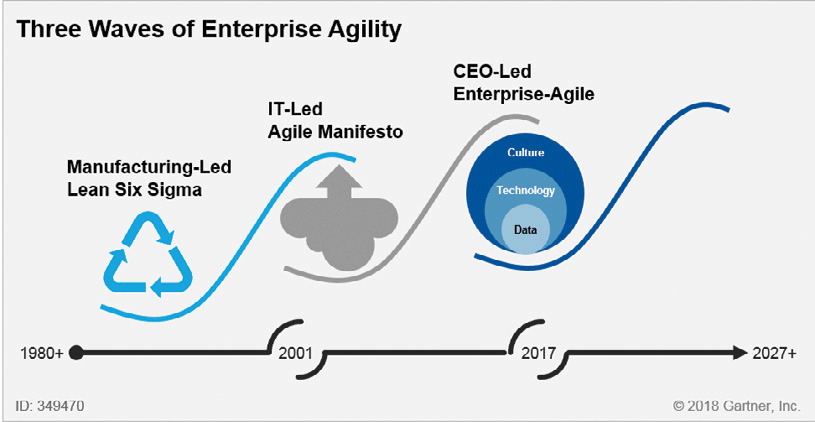
Third-wavers draw on experience from four decades of change during the rise of the digital era. They’ve learnt from a first wave of business productivity improvement practices applied late last century, such as Lean Six Sigma and business process engineering. They’ve taken lessons from a second wave of agile principles and practices adopted by IT early this century.
Third wavers confidently experiment to reform their trinity of organisational assets: culture, technology and data. They’re now evolving from old world enterprises into new world, resilient, enterprise agile digital businesses.
BNP Paribas Fortis (BNPPF), the leading bank in Belgium, is one such pioneer. I had the good fortune of interviewing the bank’s senior executives. A fintech or digital native bank and a traditional bank like BNPPF differ in that the former grew up fast in a distributed, connected, constantly experimenting, digital world; while the latter inherited a business framework optimized for historical conditions.
While it might be possible to undergo digital evolution, BNPFF decided that an enterprise "revolution" from the inside-out may be a more rational and effective response to new, irrational, external business conditions. The CEO and board embarked on a path to change in 2016 in response to market signals. The CEO declared: "This is not an IT story, it's a bank story."
Champion digital business ambition
Leadership of successful enterprise agile transformation sits squarely with the CEO. They’re the champion of the enterprise agile vision, driven by both fear and hope, and by the unpredictable threats and extraordinary opportunities of the digital business era. Their clear digital business ambition is not just to optimise, but to transform their organisation.
Third-wave CEO and transformation leaders commonly exhibit a strong bias for action, getting things done in agile terms to enact change quickly and iteratively, learning and adapting as they go.
The CEO needs resilience and confidence to ride out a long-term, multifaceted set of radical interventions that will disrupt the organisation from within. They also require capable leaders who are passionate about the future vision and have the perseverance to see the transformation through to completion, rallying against the naysayers.
Third wavers confidently experiment to reform their trinity of organisational assets: culture, technology and data
Attract third wave capability
Traditional leadership capability needs an injection of new organisational DNA. One of the first steps in realising BNPPF's digital business ambition was recognising the need for leadership capability to design and engineer potentially radical behavioural, operational and technical change. The bank decided to find and appoint a C-level transformational leadership triumvirate of third-wave leaders.
Third wavers find and appoint business and technology leaders who’ve experienced one or more transformation attempts. They have the “scars” and acumen acquired designing, leading and participating in conscious organisational change. Such leaders are evolved digital business leaders who are willing to ride the tumultuous waves of change with the CEO.
Develop a transformation roadmap
Many established organisations have heard the call for change to remain competitive in a disrupted business environment. Few are successfully moving swiftly and effectively enough to make sense of the 21st century business model and retrofit an appropriate design in their enterprise. Even when they’ve exceptional leadership with a bold vision, the task of harnessing and turning the business is proving difficult. However, enterprises that are becoming new world digital businesses start with a loose, principle-based roadmap traversing culture, technology and data.
Adopt agile principles
The third wave of organisational change appropriates and applies agile principles and practices top-down and bottom-up to enable deep rich cross-functional collaboration, fluid communications and rapid flow of idea to action.
Traditional siloed structures are flattened and recast to look more like a network of teams than a hierarchy. An agile practice discipline of continual, enterprise-wide prioritisation across a backlog or portfolio of potential investment, balances limited funds, effort, time and resources across limitless ideas, projects, and activities.
This helps third-wave organisations move more quickly towards their shared objective of digital business transformation. Productivity and velocity increases incrementally as the transformation gains assurance and validity from even small, early results. The change is experiential.
What does success look like?
During the first year of its transformation,BNPPF’s leaders said people were flourishing and developing themselves. Its new governance model has changed the approach to IT demand management and priority alignment across business units. Business trust and engagement with IT is slowly shifting. The bank is now starting to protect and use dynamic, constantly flowing, distributed data that digital business generates, which leads to the creation of digital products.
Overall, executives say the major change is its ability to scale its digital business model. BNPPF was declared "Bank of the Year — Belgium" in November 2017 by The Banker magazine.
Established organisations successfully adapting to digital business conditions can deliver growth and profit from disruption. Boards and shareholders are satisfied when they start to see these investments in change delivering traditional business measures of growth in market share, then revenue, and finally, margins.
