

A featured contribution from Leadership Perspectives: a curated forum reserved for leaders nominated by our subscribers and vetted by the Construction Tech Review Advisory Board.

Accelerate
Agile and Quality Decision Making

Eric Byron
Agility is not just about speed. Agility is really about being able to make good decisions, quickly, with the right information, and at the right level within the organization. This article will talk about how to use a RACI model, how to distinguish the easy decisions you should delegate, and how to stay agile when the hard decisions need more information.
Let’s start our discussion with the RACI model. In case you are not familiar with it, RACI stands for Responsible, Accountable, Consulted, and Informed. It is a way to capture and agree upon roles and interactions. Generally speaking, one person (often a leader) is accountable for the results. They may delegate responsibility to someone on their team to execute on an agreed strategy or plan, but they are still accountable. In theory, when you delegate responsibility, you are also delegating authority to make certain decisions. This assumes a degree of discussion and agreement on what decisions that delegates can make. This is also where many forms of “empowerment” fail. We delegate responsibility but try to hang on to decision making authority. When we do that we are the road block to agility. When we leave ambiguity around what decisions someone can make we also cause confusion and stress.
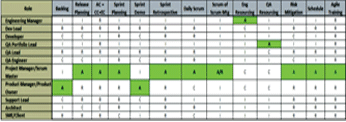
A team may make dozens or even hundreds of decisions each day. Some are minor, like decisions on how to code a low risk piece of functionality. Some are more important, like deciding what functionality to prioritize in the work plan (sprint plan). Look at this example of a RACI chart from a slide share I found online.
In this example, there are 7 people responsible for sprint planning. How do 7 people reach consensus on the sprint plan? Honestly, for me, this is a formula for tremendous waste of time and effort.
I’ve been there. Between story point poker, and backlog grooming sessions, release planning, and finally getting to sprint planning, the team will have spent a tremendous amount of time on non-value added work. I’m not saying that I don’t like Scrum or Agile practices.
The Goal Is To Know The Difference So You Can Get Out Of The Way And Let The Low Risk Decisions Be Made By Those Most Qualified To Make Them
I’m saying, if you have 7 people responsible for the same set of decisions, you have a problem. I should also point out that only one person can be accountable when using a RACI model, so the example is good in that regard.
Fail Fast, Fail Cheap
I’m also a big fan of a leadership model that intentionally gives people some room to fail and learn from their mistakes. Real agility is about learning to fail fast, not about avoiding failure. If we micro manage the team to make sure everyone has input on every decision to try to make sure no bad decisions are ever made, we will be the opposite of agile. Often, it is critical that we make a decision without having all the information. The key here is to understand the amount of risk associated with the decision. One criterion I love is the simple question, “is the decision irreversible?” Of course, there are grey areas in the interpretation of “irreversible” but the point is, sometimes it is better to try something understanding that if it fails we have learned something and that new knowledge is valuable. On the other hand, if we make a decision that will have long term implications, without proper discussion and postponement of the decision until the right information is available, it can have disastrous effect. Agile
is not reckless. If you don’t have all the information needed, you quickly design a set of experiments to gather the information you need.
Low vs High Risk
Successful agility in decision making requires the ability to categorize decisions. I’ll keep this real simple. Have just two categories: low risk and high risk. One way to look at this is low risk decisions can easily be reversed but high risk decisions cannot. The goal is to know the difference so you can get out of the way and let the low risk decisions be made by those most qualified to make them. On the other hand, make sure high risk decisions are made with the most confidence you can muster, based on data (not emotion or intuition). I also have to make a point here of being careful not to ignore the data that leads you towards the decision you don’t want to make. Being a strong agile leader, means making hard decisions when the data tells you to pivot.
Conclusion
A RACI chart can be a valuable tool for bringing clarity to a team on roles and interactions. That said, if you also want to be agile, focus on the speed and quality of decision making within that RACI model. Fail fast when you need more information, and let the data inform hard decisions.
